Time Complexity of AVL Tree Operations: Big-O Notation Explained
When computer scientists evaluate data structures, they rely on 'Big-O Notation' to describe the worst-case scenario. It answers a fundamental question: If the amount of data in this structure grows to millions or billions of records, how severely will the performance slow down?
When computer scientists evaluate data structures, they rely on "Big-O Notation" to describe the worst-case scenario. It answers a fundamental question: If the amount of data in this structure grows to millions or billions of records, how severely will the performance slow down?
The entire reason AVL trees were invented in 1962 was to solve a specific Big-O performance issue found in standard Binary Search Trees. In this guide, we will break down the mathematical time complexity of searching, inserting, deleting, and traversing data within an AVL tree.
The Big-O of AVL Tree Search: $O(\log n)$
In a standard Binary Search Tree (BST), inserting already-sorted data causes the tree to grow in a single straight line. Searching that skewed tree requires checking every single node, resulting in a worst-case time complexity of $O(n)$ (Linear Time). If you have one million records, it takes one million steps to find the last one.
Because an AVL tree rigorously maintains a height balance—where the left and right subtrees differ by no more than one level—it guarantees that the tree will always be as shallow as mathematically possible.
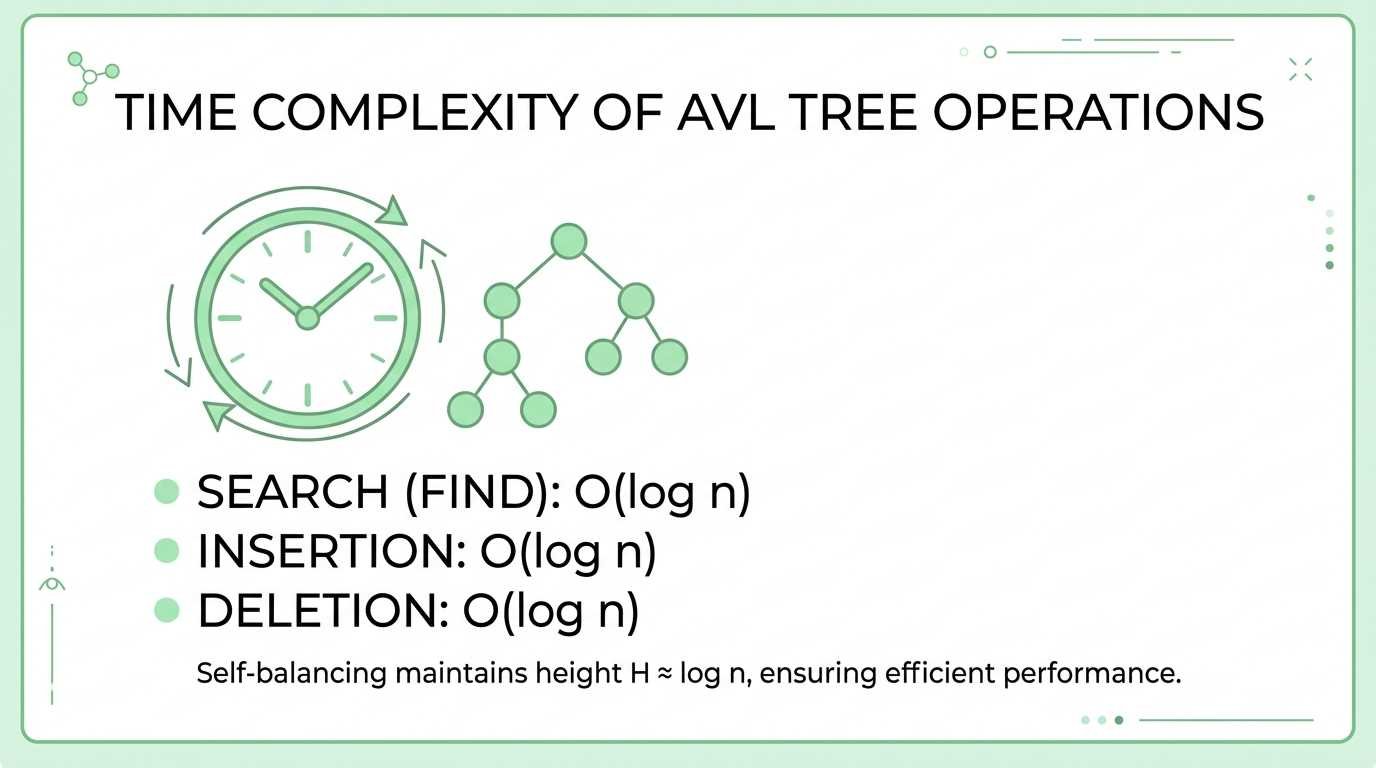
This enforced balance guarantees a worst-case search time complexity of $O(\log n)$ (Logarithmic Time).
- If your AVL tree has 1,000 nodes, finding a specific value takes a maximum of roughly 10 steps.
- If your AVL tree has 1,000,000 nodes, finding a value takes a maximum of roughly 20 steps.
By acting as a visual avl tree calculator, tools like AVL Tree Visualizer allow you to count these steps dynamically. Insert 30 random nodes and search for a leaf node; you will see the highlight path traverse downward, eliminating half the remaining tree at every single step.
The Big-O of Insertion and Deletion: $O(\log n)$
Updating the data in an AVL tree requires two distinct phases: finding the correct location, and then updating the structure.
- Traversal Phase: Just like searching, the algorithm must navigate from the root to the correct leaf position to insert or delete a value. Because the tree is balanced, this takes $O(\log n)$ time.
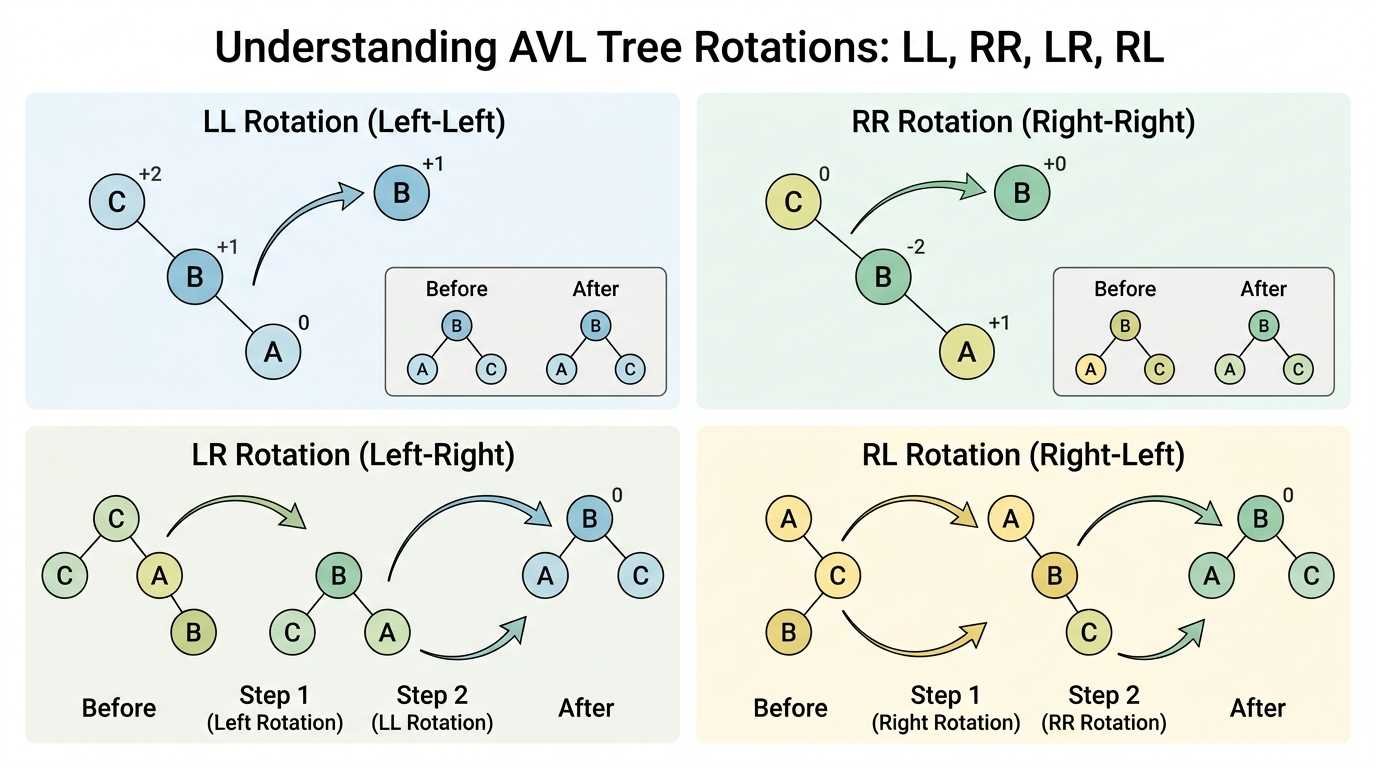
- Balancing Phase (Rotations): Once the node is inserted or removed, the algorithm walks back up the tree, updating height metrics and checking the balance factor. If a rotation (LL, RR, LR, or RL) is required, the actual pointer manipulation takes $O(1)$ (Constant Time) because it only involves changing a few memory references, regardless of the tree's overall size.
When you add $O(\log n)$ and $O(1)$ together, the dominant term wins. Therefore, the total time complexity for both insertion and deletion in an AVL tree remains strictly $O(\log n)$.
Tree Traversal Operations: $O(n)$
While searching for a single value is extremely fast, what happens when you need to read every value in the tree? For example, you might want to print all the numbers in ascending order.
This requires a traversal algorithm (such as In-order, Pre-order, or Post-order traversal).
Because the algorithm is fundamentally required to visit every single node in the data structure once, the time complexity is intrinsically tied to the total number of nodes ($n$). Therefore, the time complexity for any full tree traversal is $O(n)$.
- In-order Traversal: Visits Left Subtree, then the Root, then the Right Subtree. In an AVL tree, this will always return the data in perfectly sorted ascending order.
- Pre-order Traversal: Visits the Root, then Left Subtree, then Right Subtree. Used heavily for copying trees.
- Post-order Traversal: Visits Left Subtree, Right Subtree, then the Root. Safest method for deleting an entire tree from memory.
Summary of AVL Tree Complexity
For quick reference for exams or technical interviews, here is the time and space complexity matrix for an AVL tree:
| Operation | Average Case | Worst Case |
|---|---|---|
| Search | $O(\log n)$ | $O(\log n)$ |
| Insert | $O(\log n)$ | $O(\log n)$ |
| Delete | $O(\log n)$ | $O(\log n)$ |
| Traversal | $O(n)$ | $O(n)$ |
| Space (Memory) | $O(n)$ | $O(n)$ |
If you want to see these performance metrics in action rather than just trusting the mathematics, fire up an interactive simulator or tree traversal calculator and watch the traversal paths execute in real time.