Red-Black Tree vs. AVL Tree: A Simulator Comparison
When you move beyond standard Binary Search Trees (BST), you are immediately faced with a choice between two famous self-balancing data structures: the AVL Tree and the Red-Black Tree.
When you move beyond standard Binary Search Trees (BST), you are immediately faced with a choice between two famous self-balancing data structures: the AVL Tree and the Red-Black Tree.
Both structures guarantee $O(\log n)$ time complexity for search, insertion, and deletion. Because their Big-O notations are identical, computer science students and software developers often wonder why both exist and which one they should use. The answer lies not in their theoretical limits, but in their operational trade-offs.
By using an interactive simulator to test both structures, we can clearly visualize the difference between strict balancing and loose balancing.
The Core Difference: Strict vs. Loose Balancing
The AVL Tree: Strict Height Balancing
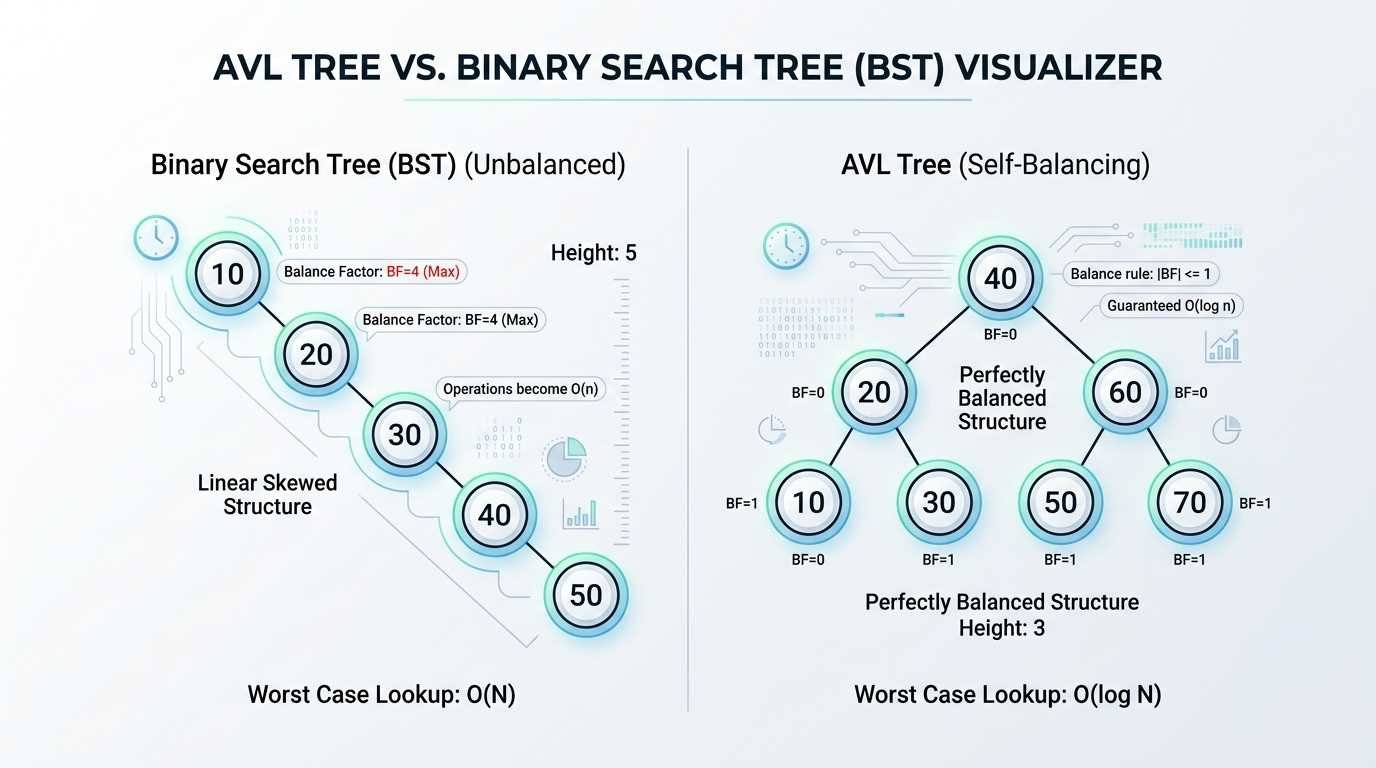
As we've explored using our online AVL Tree Visualizer, AVL trees enforce a very strict rule: the height of the left and right subtrees of any node can differ by no more than $1$.
- The Result: The tree remains incredibly flat and perfectly balanced.
- The Cost: To maintain this strict perfection, the AVL tree must perform structural rotations very frequently during insertions and deletions.
The Red-Black Tree: Color-Coded Loose Balancing
A Red-Black tree takes a more relaxed approach. Instead of calculating exact mathematical heights, every node is painted either "Red" or "Black." The tree balances itself based on rules regarding how these colors can be arranged (e.g., a red node cannot have a red child, and every path from a node to its descendant leaves must contain the same number of black nodes).
- The Result: The tree is allowed to become slightly unbalanced. The longest path to a leaf can be up to twice as long as the shortest path.
- The Cost: Searches might take a fraction of a millisecond longer because the tree is slightly taller, but the tree saves massive amounts of processing power by performing far fewer rotations during data updates.
Visualizing the Performance Trade-Off
Let's look at what happens when you insert identical data into a simulator for both trees.
Imagine inserting the numbers 1 through 10 in sequential order.
In an AVL Simulator: The tree constantly monitors its balance factor. Every time the balance tips past $+1$ or $-1$, it triggers a rotation. By the time you insert all 10 numbers, the AVL tree has executed multiple Left-Left rotations to keep the branches perfectly shallow.
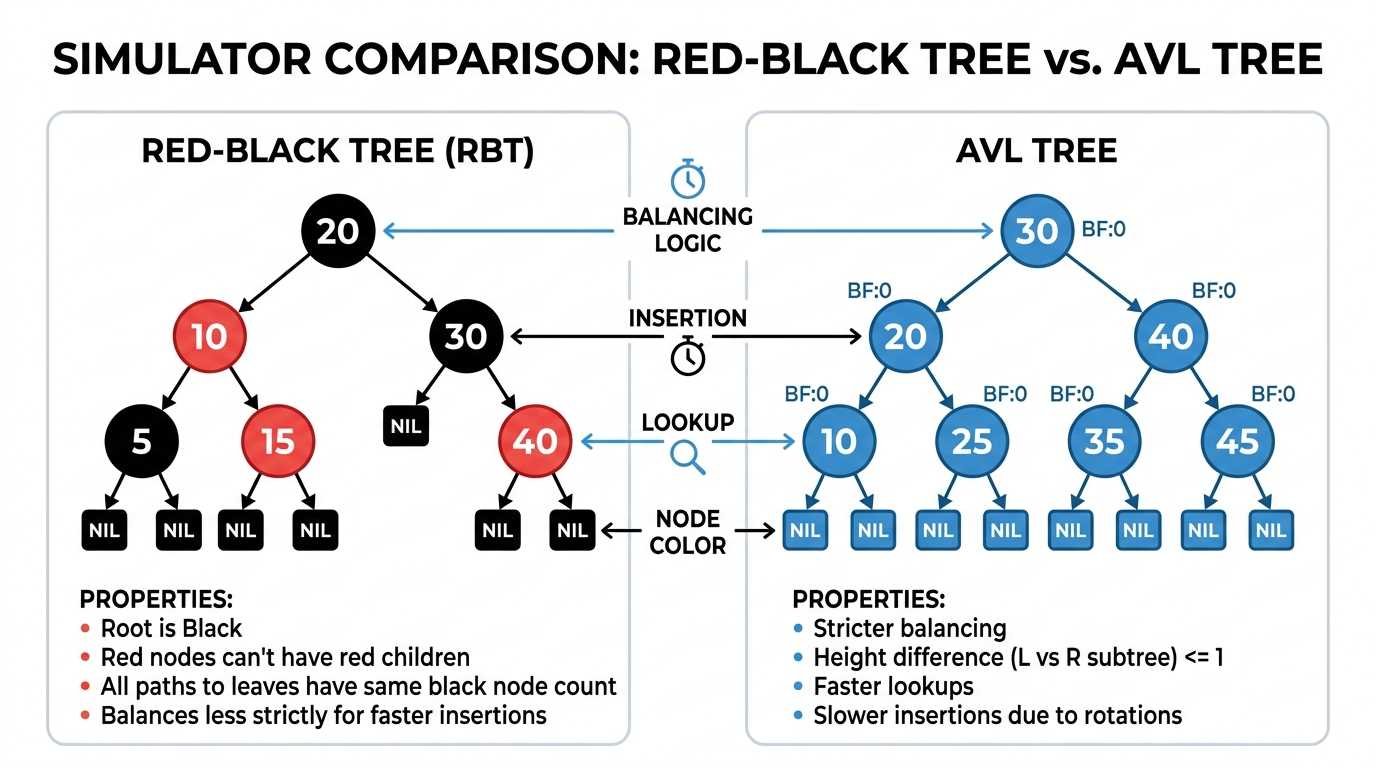
In a Red-Black Tree Simulator: The tree primarily uses color flips (changing a node from red to black and vice versa) to resolve violations. It only resorts to structural rotations when color flipping isn't enough. By the time you insert all 10 numbers, the Red-Black tree is noticeably taller and asymmetrical, but it required fewer memory-pointer adjustments to get there.
When to Use Which? (Real-World Applications)
Because of these distinct behavioral differences, system architects choose between them based on whether an application is Read-Heavy or Write-Heavy.
| Feature | AVL Tree | Red-Black Tree |
|---|---|---|
| Balance Mechanism | Strict Height Factors (-1, 0, 1) | Node Colors (Red/Black properties) |
| Search Speed (Read) | Faster. The tree is strictly balanced and shallow. | Slightly Slower. The tree can be up to 2x taller. |
| Insertion/Deletion (Write) | Slower. Requires frequent, complex rotations. | Faster. Requires fewer rotations, heavily relies on color flips. |
| Standard Library Usage | Less common in standard libraries. | Used in Java's TreeMap, C++ std::map, and Linux Kernel CPU scheduling. |
Choose an AVL Tree if you are building an application like a dictionary or a language lookup tool. The database is written once (or rarely updated) but is searched millions of times a day. You want the absolute fastest lookup speed possible.
Choose a Red-Black Tree if you are building a system like an operating system task scheduler or a real-time gaming engine. Data is constantly being inserted and deleted every millisecond, and you cannot afford the CPU overhead of constant AVL rotations.
By testing your specific data patterns in a simulator, you can move past the theory and actually observe the operational cost of your data structure choices.