Step-by-Step AVL Tree Visualization with Balance Factors
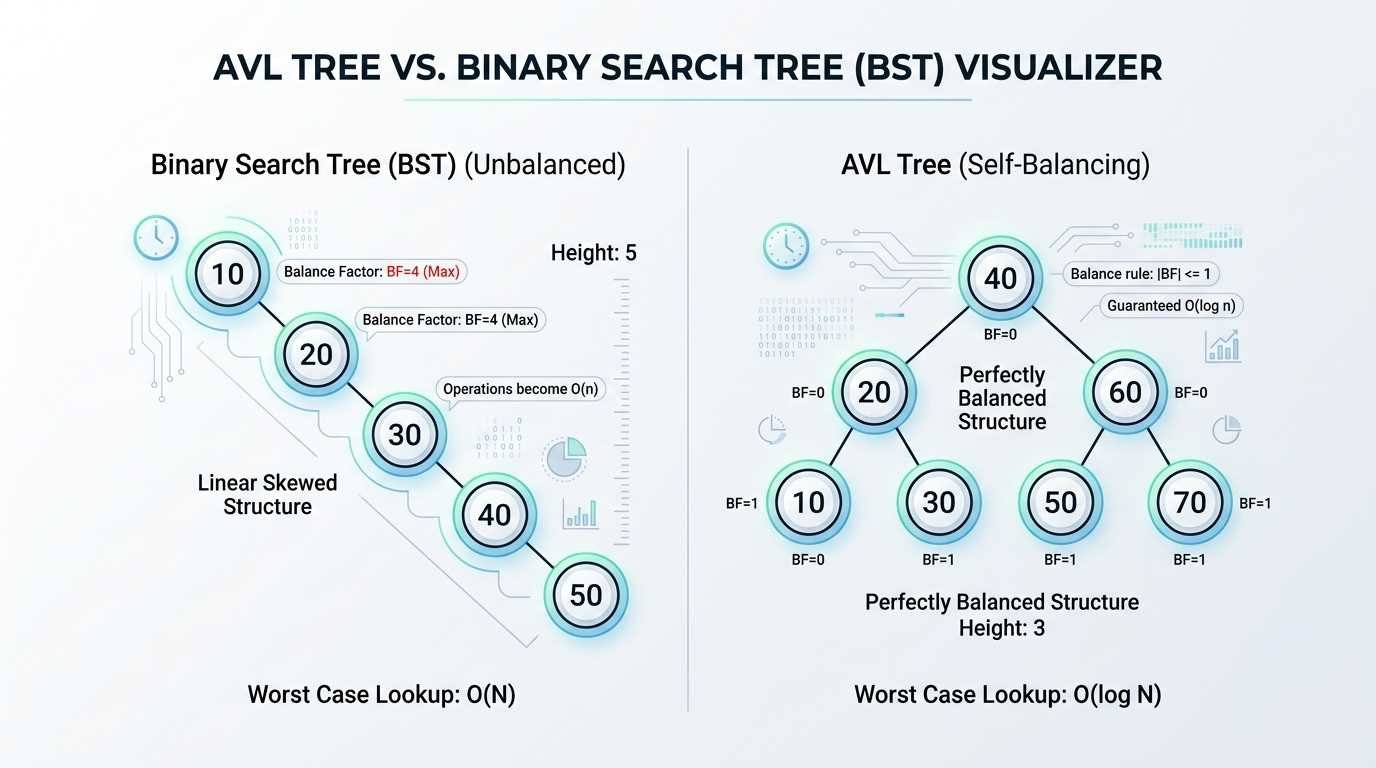
When building or interacting with self-balancing data structures, understanding the underlying mechanics of tree balancing is critical. An AVL Tree is a highly optimized, self-balancing Binary Search Tree (BST) designed to prevent the skewed, linked-list-like degradation that occurs in standard BSTs during sequential data insertion.
The secret to this consistent O(log n) performance lies in a single metric: the Balance Factor.
This guide breaks down how the balance factor dictates tree structure, how it triggers automated rotations, and how you can observe these changes using an interactive AVL tree visualization tool.
What is the Balance Factor?
In an AVL tree, the height of the left and right subtrees of any node can differ by at most one. The tree maintains this strict property by calculating a balance factor for every node after an insertion or deletion operation.
Based on this calculation, a node is classified into one of three acceptable states:
- -1: The node is slightly right-heavy but remains balanced.
- 0: The node is perfectly balanced.
- +1: The node is slightly left-heavy but remains balanced.
If an operation causes a node's balance factor to become greater than 1 or less than -1, the AVL tree violates its core property. The tree must immediately halt normal operations and perform structural rotations to restore balance.
Visualizing the Imbalance Trigger
Let's look at how this is calculated in code. If you were writing this logic in Python to manage nodes, the class and calculation would look like this:
class AVLNode:
    def __init__(self, key):
        self.key = key
        self.left = None
        self.right = None
        self.height = 1

def get_height(node):
    if not node:
        return 0
    return node.height

def get_balance_factor(node):
    if not node:
        return 0
    return get_height(node.left) - get_height(node.right)
Whenever a new node is inserted, the recursive function travels back up the tree, updating the height of each ancestor node and checking the get_balance_factor. If it detects an imbalance, it initiates a rotation.
The Four AVL Rotations Explained
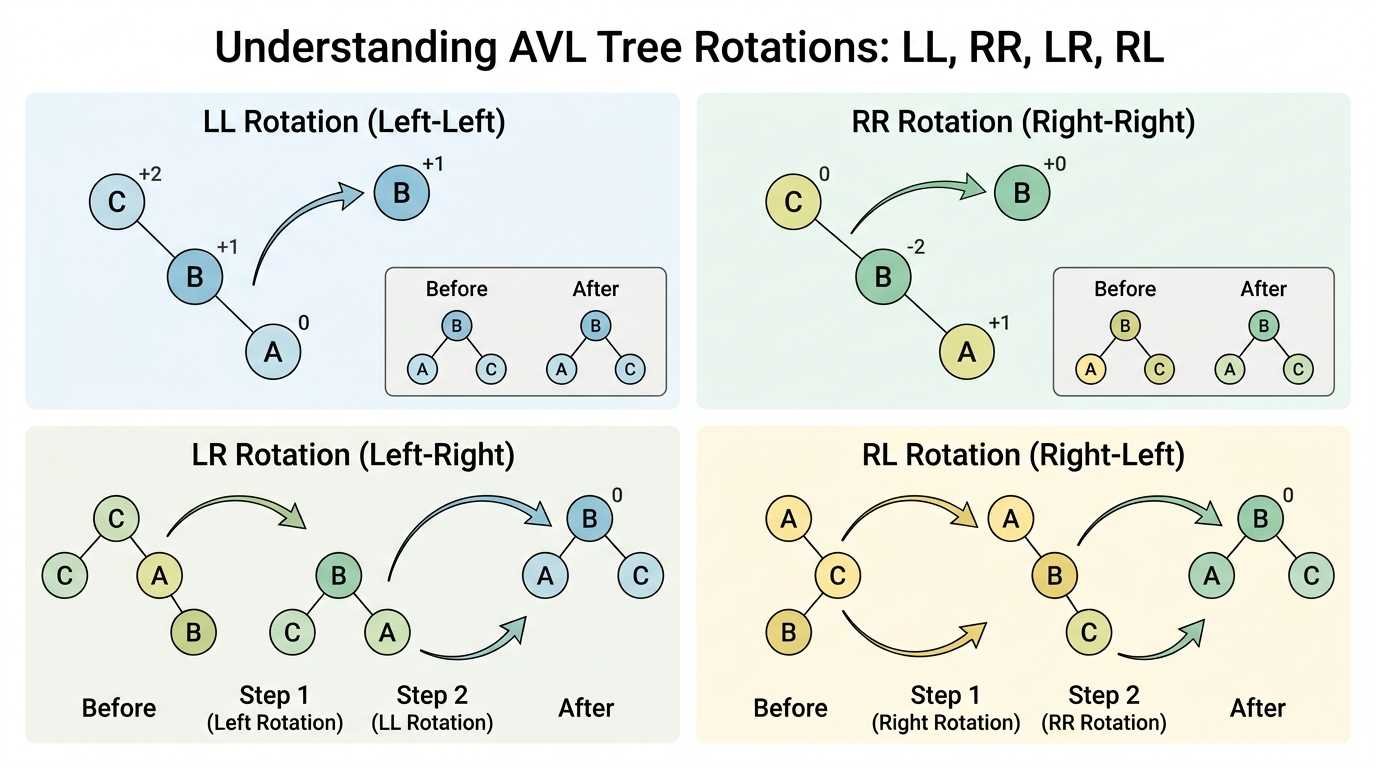
When the balance factor triggers an alert, the tree uses one of four specific rotations depending on exactly where the new node was inserted. Using an interactive visualization simulator is the best way to see these in action.
1. Left-Left (LL) Rotation
- The Trigger: A node is inserted into the left subtree of the left child, causing the root's balance factor to hit +2.
- The Fix: A single right rotation. The left child is pulled up to become the new root, and the old root is pushed down to become the right child.
2. Right-Right (RR) Rotation
- The Trigger: A node is inserted into the right subtree of the right child, pushing the root's balance factor to -2.
- The Fix: A single left rotation. The right child becomes the new root, and the original root becomes the new left child.
3. Left-Right (LR) Rotation
- The Trigger: A node is inserted into the right subtree of the left child. This creates a "zigzag" shape. A single rotation won't fix it.
- The Fix: A double rotation. First, the tree performs a left rotation on the left child, converting the structure into a straight Left-Left case. Then, it performs a right rotation on the root to restore complete balance.
4. Right-Left (RL) Rotation
- The Trigger: A node is inserted into the left subtree of the right child.
- The Fix: Another double rotation. The tree executes a right rotation on the right child to create a Right-Right case, followed by a left rotation on the root.
Why Interactive Visualization Matters
Reading textbook definitions of double rotations can be confusing. The most effective way to grasp how the balance factor actively manipulates pointers in memory is to use an online AVL tree generator or visualizer.
By manually inserting a sequence of numbers, you can watch the traversal path highlight dynamically, see the balance factor of each node update in real-time, and observe the exact moment the rotation logic takes over. When you build or debug your own search trees, having a visual mental model of how the balance factor operates ensures you can write accurate insertion and deletion algorithms without pointer reference errors.